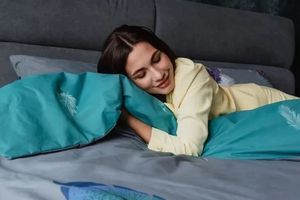

A memory foam pillow is an orthopaedic sleep accessory made of high-tech Memory Foam, which responds to body heat and weight to follow the exact contours of the head and neck, giving them anatomically correct support. Because the foam does not push back against muscles and blood vessels, you wake up without neck pain, without creases on your face and with a feeling of lightness.
Many people sleep on ordinary feather pillows for years and suffer from chronic morning headaches. When the neck muscles are tense all night, normal blood flow is disrupted, which reduces the oxygen supply to the brain. A Memory pillow solves this problem by keeping the spine perfectly aligned. A carefully calculated bolster height and material elasticity reduce how often you toss and turn at night by 40%, turning your bed into a place of real relaxation.
How a Memory Pillow Works: The Physical Properties of the Material
To understand why this accessory is so popular, you need to look at the structure of Memory Foam. The material consists of billions of open micro-cells that react to heat. When you lie down, the foam becomes elastic at around 36.6 °C, sinks smoothly under the weight of your head and fills all the space under the curve of your neck.
For everyday home use, experts recommend models with a density of 45 to 60 kg/m³. They last a long time (5 years or more) and keep their resilience. We have collected the exact technical parameters and prices in a comparison table:
| Technical parameter | Budget model (synthetic latex) | Premium Memory Foam | Natural perforated latex |
|---|---|---|---|
| Filling density | 25–35 kg/m³ | 45–60 kg/m³ | 60–75 kg/m³ |
| Memory effect | Weak, springs back quickly | Maximum, smooth sinking | None, highly springy |
| Lifespan | 1–2 years before it loses shape | 5–7 years of stable support | Over 10 years without changing shape |
| Approximate price in Ukraine | 400–700 UAH | 1,200–2,500 UAH | 2,500–4,500 UAH |
| Core care | Can be washed on a delicate cycle | Washing the foam is not allowed | Dry cleaning only, keep out of the sun |
Honest Downsides of Orthopaedic Foam: Who It Definitely Does NOT Suit
Healthy sleep is not about vague advertising slogans, so it is important to be open about the material's drawbacks. Despite its great benefits for the spine, Memory Foam has some specific features that will not suit everyone.
Here are the honest downsides and limitations buyers come across:
- Heat retention: Polyurethane foam tends to store body heat. In hot summer months without air conditioning, it can feel too stuffy to sleep on.
- Sensitivity to room temperature: If the bedroom is cool in winter (below 18 °C), the foam becomes as hard as stone and only starts to soften a few minutes after contact with your skin.
- Distinct factory smell: A new pillow has a noticeable chemical smell of new foam after unpacking, which disappears completely within 48–72 hours.
- Who a Memory pillow does NOT suit: It is not suitable for people who turn over very often and restlessly all night, as the foam will not have time to adjust to the constant changes of position. It is also not recommended for people who sweat heavily at night.
Who a Memory Foam Pillow Suits
When choosing an orthopaedic pillow, buyers often compare Memory Foam with classic natural latex. Both materials are considered beneficial, but they work very differently.
Let's compare these two popular formats in a short table:
| Comparison criterion | Memory Foam filling | Natural springy latex |
|---|---|---|
| Feel under the head | Complete relaxation, a "weightless" effect | Very springy, pushes back slightly |
| Effect on blood vessels | Zero pressure, helps prevent migraines | Stable, firm head support |
| Response to movement | Changes shape slowly (2–3 second delay) | Adjusts instantly to any turn |
The verdict: who should choose what: A Memory pillow is ideal for people with chronic neck pain, osteochondrosis, frequent headaches and blood pressure problems. It practically eliminates pressure on the capillaries. Springy latex is better for those who prefer classic firm support and a solid base, and for people who sweat a lot during sleep.
How to Choose and Set Up a Memory Pillow: A Step-by-Step Guide
To get the most from your purchase, choose the shape and bolster height using a clear plan. Follow these steps:
- Identify your favourite sleeping position: If you sleep on your side, buy an ergonomic model with two wave-shaped bolsters. For sleeping on your back or stomach, a classic rectangular shape is better.
- Measure the right bolster height: Measure the width of your shoulder from your neck to the joint (for example, 12 cm). The height of the side bolster should match this figure to within 1 cm.
- Check for an inner protective cover: Premium pillows always have two covers: an inner mesh cover to protect the foam and a washable outer zipped cover (calico or jersey).
- Test it by pressing in the shop: Press the foam with your palm. Good-quality Memory Foam should return smoothly to its original shape in 3 to 5 seconds.
Frequently Asked Questions About Memory Orthopaedic Pillows (FAQ)
Why can't Memory Foam be washed in the usual way?
When it comes into contact with water, the microporous cells of the polyurethane foam fill up completely with moisture. During spinning or drying, the water tears the thin inner walls of the material. The pillow will permanently lose its memory effect and turn into an ordinary piece of hard foam.
How long does it take to get used to a new orthopaedic shape?
It takes the neck muscles 7 to 14 days on average to adapt to the correct position. For the first 3–4 nights, the bed may feel uncomfortable and your neck may feel tense. This is a normal physiological adjustment of the spine, and you simply need to wait it out.
Can I trim a Memory pillow to a lower height at home?
No, you should not. Cutting it with scissors at home will ruin the factory shape and damage the micro-cells. If the pillow seems too high, it is better to buy a model with removable inner foam layers that let you adjust the height from 8 to 12 cm.
How do I care for a Memory pillow if it can't be washed?
Care consists of washing the outer pillowcase cover every 1–2 weeks at 40 °C. The Memory Foam itself only needs airing gently outdoors once a month in a shaded place, avoiding direct sunlight, which breaks down the polymers.